 | |
| Manufacturer | Nokia |
|---|---|
| Available | 2007 |
| Screen | 240x320 px, 2.6 in, TFT LCD |
| Camera | 5 Megapixels (Back) |
| Second camera | CIF video call (Front) |
| Operating system | Symbian OS v9.2, S60 3rd Edition |
| Input | Keypad |
| CPU | Dual 332 MHz Texas Instruments OMAP 2420 (ARM11-based) |
| Memory | 160 MB |
| Memory card | MicroSD |
| Networks | HSDPA (3.5G),Quad band GSM / GPRS / EDGE GSM 850, GSM 900, GSM 1800, GSM 1900 |
| Connectivity | USB 2.0, Bluetooth 2.0, Wi-Fi b/g, InfraRed |
| Battery | BL-5F (950 mAh) |
| Physical size | 99×53×21 mm |
| Weight | 120 g |
| Form factor | Slider |
| Successor | Nokia N96 |
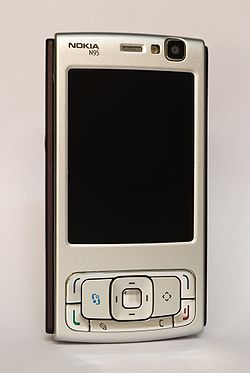
The Nokia N95 (N95-1, internally known as RM-159) is a smartphone produced by Nokia as part of their Nseries line of portable devices. The N95 runs Symbian OS v9.2, with a S60 3rd Edition user interface. The phone has a two-way sliding mechanism, which can be used to access either media playback buttons or a numeric keypad.
Its capabilities include: a Global Positioning System receiver with maps and optional turn-by-turn directions; a 5 megapixel digital camera with Carl Zeiss optics, flash, video recording and video conferencing; wireless connectivity via HSDPA, IrDA, 802.11x and Bluetooth; a portable media player with the ability to download podcasts over the air; a FM Radio tuner; Composite Video output via included cable; multi-tasking to allow several applications to run simultaneously; a web browser with support for HTML, JavaScript and Adobe Flash; messaging via SMS, MMS and e-mail; Office suite and organizer functions; and the ability to install and run third party Java or Symbian mobile applications.
Since the introduction of the original N95-1, several updated versions have been released as well: The N95 8GB with 8 gigabytes of internal storage and a larger display, the N95 NAM and the N95 8GB NAM with support for North American UMTS (3G) bands, and finally the lower cost N95-5 and N95-6 for the Chinese market.
No comments:
Post a Comment