ALSO VISIT FOR LATEST SONGS AND PICTURES

http://www.bollywoodlatestsongsandpictures.blogspot.com/

Bank of England


A Series E (revised) £10 Bank of England note.

A Series E (revised) £20 Bank of England note.

Banknote printing facility in Loughton.

In 1921 the Bank of England gained a legal monopoly on the issue of banknotes in England and Wales, a process that started with the Bank Charter Act of 1844 when the ability of other banks to issue notes was restricted.

The bank issued its first banknotes in 1694, although before 1745 they were written for irregular amounts, rather than predefined multiples of a pound. It tended to be times of war, which put inflationary pressure on the British economy, that led to greater note issue. In 1759, during the Seven Years' War, when the lowest-value note issued by the Bank was £20, a £10 note was issued for the first time. In 1793, during the war with revolutionary France, the Bank issued the first £5 note. Four years later, £1 and £2 notes appeared, although not on a permanent basis. Notes did not become entirely machine-printed and payable to the bearer until 1855.

At the start of the First World War, the government issued £1 and 10-shilling Treasury notes to supplant the sovereign and half-sovereign gold coins. The first coloured banknotes were issued in 1928, and were also the first notes to be printed on both sides. The Second World War saw a reversal in the trend of warfare creating more notes when, in order to combat forgery, higher denomination notes (at the time as high as £1,000) were removed from circulation.

All Bank of England notes issued since Series C in 1960 depict Queen Elizabeth II on the obverse side, in full view facing left; her image also appears as a hidden watermark, facing right; recent issues have the EURion constellation around.

The custom of depicting historical figures on the reverse began with William Shakespeare in Series D in 1970. Since then, many other figures have featured on successive issues.

United Kingdom pounds sterling


Pound sterling banknotes the British Islands
ISO 4217 Code GBP
User(s) UK, Jersey, Guernsey,
Isle of Man, Falkland Islands, Gibraltar, Saint Helena
Subunit
1/100 penny
Symbol £
penny p
Banknotes
Freq. used £5, £10, £20, £50
Rarely used £1 (Scot., Jersey, Guernsey, IoM only), £100 (Scot. & N. Ireland only)

higher values exist such as £100,000,000 (Titan) bank note, however, usage is restricted

Central bank Bank of England
Website www.bankofengland.co.uk
Printer Issuing banks:

English (inc.Wales) notes:

Bank of England

Scottish notes:

Bank of Scotland
Royal Bank of Scotland
Clydesdale Bank

Northern Irish notes:

Northern Bank
First Trust Bank
Ulster Bank
Bank of Ireland

Crown dependencies:

States of Guernsey
States of Jersey
Isle of Man Government

Note printer:

De La Rue

Sterling banknotes are the banknotes in circulation in the British Islands (encompassing the United Kingdom and the British Crown dependencies), denominated in pounds sterling (symbol: £; ISO 4217 currency code GBP). One pound is equivalent to 100 pence.

The pound is the official currency of the United Kingdom and the Crown dependencies of Britain. Three British Overseas Territories also have currencies called pounds which are at par with the pound sterling.

In most countries of the world the issue of banknotes is handled exclusively by a single central bank or government, but in the United Kingdom seven retail banks have the right to print their own banknotes in addition to the Bank of England; Sterling banknote issue is thus not automatically tied in with one national identity or the activity of the state. The arrangements in the UK are unusual but not unique, as a comparable system is used in Hong Kong, where three banks issue their own banknotes in addition to the Hong Kong government.

The Moon

Moon Moon symbol
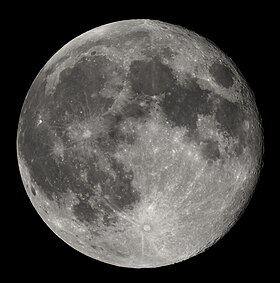
Full Moon
A full Moon as seen from Earth's northern hemisphere
Designations
Adjective Lunar
Orbital characteristics
Perigee 363,104 km (0.002 4 AU)
Apogee 405,696 km (0.002 7 AU)
Semi-major axis 384,399 km (0.002 57 AU[1])
Eccentricity 0.054 9[1]
Orbital period 27.321 582 d (27 d 7 h 43.1 min[1])
Synodic period 29.530 589 d (29 d 12 h 44 min 2.9 s)
Average orbital speed 1.022 km/s
Inclination 5.145° to the ecliptic[1]
(between 18.29° and 28.58° to Earth's equator)
Longitude of ascending node regressing by one revolution in 18.6 years
Argument of perigee progressing by one revolution in 8.85 years
Satellite of Earth
Physical characteristics
Mean radius 1,737.10 km (0.273 Earths)[1][2]
Equatorial radius 1,738.14 km (0.273 Earths)[2]
Polar radius 1,735.97 km (0.273 Earths)[2]
Flattening 0.001 25
Circumference 10,921 km (equatorial)
Surface area 3.793 × 10⁷ km² (0.074 Earths)
Volume 2.195 8 × 10¹⁰ km³ (0.020 Earths)
Mass 7.347 7 × 10²² kg (0.012 3 Earths[1])
Mean density 3,346.4 kg/m³[1]
Equatorial surface gravity 1.622 m/s² (0.165 4 g)
Escape velocity 2.38 km/s
Sidereal rotation
period
27.321 582 d (synchronous)
Equatorial rotation velocity 4.627 m/s
Axial tilt 1.542 4° (to ecliptic)
6.687° (to orbit plane)
Albedo 0.12
Surface temp.
equator
85°N[3]
min mean max
100 K 220 K 390 K
70 K 130 K 230 K
Apparent magnitude −2.5 to −12.9[nb 1]
−12.74 (mean full Moon)[2]
Angular diameter 29.3 to 34.1 arcminutes[2][nb 2]


Some details of the Earth-Moon system. Besides the radius of each object, the radius to the Earth-Moon barycenter is shown. Photos from NASA. Data from NASA. Planets are not spheres and orbits are not circles, so radii values are only indicative (and not drawn to scale). The Moon's orbital plane precesses about the Earth in an 18.6 year cycle. Its axis is located by Cassini's third law.

The Moon is Earth's only natural satellite and the fifth largest satellite in the Solar System. The average centre-to-centre distance from the Earth to the Moon is 384,403 kilometres (238,857 mi), about thirty times the diameter of the Earth. The common centre of mass of the system (the barycentre) is located at about 1,700 kilometres (1,100 mi)—a quarter the Earth's radius—beneath the surface of the Earth. The Moon makes a complete orbit around the Earth every 27.3 days[nb 3] (the orbital period), and the periodic variations in the geometry of the Earth–Moon–Sun system are responsible for the phases of the Moon, which repeat every 29.5 days[nb 4] (the synodic period).

The Moon's diameter is 3,474 kilometres (2,159 mi),[4] a little more than a quarter of that of the Earth. Thus, the Moon's surface area is less than a tenth of the Earth (about a quarter of Earth's land area, approximately as large as Russia, Canada, and the United States combined), and its volume is about 2 percent that of Earth. The pull of gravity at its surface is about 17 percent of that at the Earth's surface.

The Moon is the only celestial body on which human beings have made a manned landing. While the Soviet Union's Luna programme was the first to reach the Moon with unmanned spacecraft, the NASA Apollo program achieved the only manned missions to date, beginning with the first manned lunar mission by Apollo 8 in 1968, and six manned lunar landings between 1969 and 1972 – the first being Apollo 11 in 1969. Human exploration of the Moon temporarily ceased with the conclusion of the Apollo program, although a few robotic landers and orbiters have been sent to the Moon since that time. The U.S. has committed to return to the Moon by 2018.[5][6][7] On November 13, 2009, NASA announced the discovery of proof that water exists on the Moon.

Mozilla Firefox

Microsoft's head of Australian operations, Steve Vamos, stated in late 2004 that he did not see Firefox as a threat and that there was not significant demand for the feature set of Firefox among Microsoft's users. Microsoft Chairman Bill Gates has used Firefox, but has commented that "so much software gets downloaded all the time, but do people actually use it?"

A Microsoft SEC filing on June 30, 2005 acknowledged that "competitors such as Mozilla offer software that competes with the Internet Explorer Web browsing capabilities of our Windows operating system products." The release of Internet Explorer 7 was fast tracked, and included functionality that was previously available in Firefox and other browsers, such as tabbed browsing and RSS feeds.

Despite the cold reception from Microsoft's top management, the Internet Explorer development team maintains a relationship with Mozilla. They meet regularly to discuss web standards such as extended validation certificates. In 2005 Mozilla agreed to allow Microsoft to use its Web feed logo in the interest of common graphical representation of the Web feeds feature.

In August 2006, Microsoft offered to help Mozilla integrate Firefox with the then-forthcoming Windows Vista an offer Mozilla accepted.

In October 2006, as congratulations for a successful ship of Firefox 2, the Internet Explorer 7 development team sent a cake to Mozilla.As a nod to the browser wars, some readers joked about the cake being poisoned, while others jokingly suggested that Mozilla send a cake back along with the recipe, in reference to the open-source software movement. The IE development team sent another cake on June 17, 2008, upon the successful release of Firefox 3.

In November 2007, ASMS employee Jeff Jones criticized Firefox, claiming that Internet Explorer experienced fewer vulnerabilities and fewer higher severity vulnerabilities than Firefox in typical enterprise scenarios. Mozilla developer Mike Shaver discounted the study, citing Microsoft's bundling of security fixes and the study's focus on fixes, rather than vulnerabilities, as crucial flaws.

Mozilla Firefox

The Mozilla Corporation's relationship with Google has been noted in the media,especially with regard to their paid referral agreement. The release of the anti-phishing protection in Firefox 2 in particular raised considerable controversy: anti-phishing protection enabled by default is based on a list updated by twice-hourly downloads to the user's computer from Google's server. The user cannot change the data provider within the GUI,and is not informed who the default data provider is. The browser also sends Google's cookie with each update request. Some Internet privacy advocacy groups have expressed concerns surrounding Google's possible uses of this data, especially that Firefox's privacy policy states that Google may share information gathered with "safebrowsing" service with third parties, including business partners. Google also promoted Mozilla Firefox through YouTube until the release of Google Chrome. Recently Mozilla Security have assisted Google by pointing out a security flaw in Google's Chrome browser.

In 2005, the Mozilla Foundation and Mozilla Corporation had a combined revenue of US$52.9 million, with approximately 95 percent derived from search engine royalties. In 2006, the Mozilla Foundation and Mozilla Corporation had a combined revenue of US$66.9 million, with approximately 90 percent derived from search engine royalties. In 2007, the Mozilla Foundation and Mozilla Corporation had a combined revenue of US$75 million, with 88 percent of this sum (US$66 million) from Google.Mozilla Foundation is being audited by the IRS and some believe its non-profit status may be called into question.

Mozilla Firefox


Mozilla Firefox IconMozilla Firefox wordmark
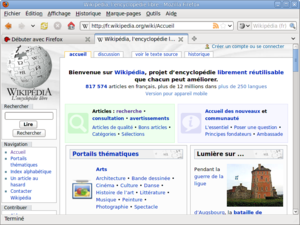
Firefox 3.5 fr.png
Firefox 3.5 displaying Wikipedia on Linux.
Original author(s) Mozilla Corporation
Developer(s) Mozilla Corporation
Mozilla Foundation
Initial release November 9, 2004 (2004-11-09)
Stable release 3.5.5 (2009-11-05; 5 days ago) [+/−]
Preview release 3.6b1 (2009-10-30; 11 days ago) [+/−]
Written in C++, XUL, XBL, JavaScript,[2] CSS[3][4]
Operating system Windows
Mac OS X
Linux
BSD
Solaris
OpenSolaris
Engine Gecko
Size 9.4 MB (Linux)
17.2 MB (Mac OS X)
7.7 MB (Windows)
(all archived)
Available in 75 languages
Development status Active
Type Web browser
FTP client
Gopher client
License MPL/GNU GPL/GNU LGPL/about:rights
Website www.mozilla.com/firefox

Mozilla Firefox is a free and open source web browser descended from the Mozilla Application Suite andmanaged by Mozilla Corporation. A Net Applications survey put Firefox at 24.07% of the recorded usage share of web browsers as of October 2009, making it the second most popular browser in terms of current use worldwide after Microsoft's Internet Explorer.[5]

To display web pages, Firefox uses the Gecko layout engine, which implements most current web standards in addition to several features which are intended to anticipate likely additions to the standards.

Latest Firefox features include tabbed browsing, spell checking, incremental find, live bookmarking, a download manager, private browsing, location-aware browsing (aka "geolocation") based exclusively on a Google service and an integrated search system that uses Google by default in most localizations. Functions can be added through add-ons, created by third-party developers, of which there is a wide selection, a feature that has attracted many of Firefox's users.

Firefox runs on various versions of Mac OS X, Microsoft Windows, Linux, and many other Unix-like operating systems. Its current stable release is version 3.5.5, released on November 5, 2009. Firefox's source code is free software, released under a tri-license GNU GPL/GNU LGPL/MPL.

AdSense


Google Adsense logo.png
Developer(s) Google Inc.
Operating system Cross-platform (web-based application)
Type Online advertising
Website www.google.com/adsense

AdSense is an ad serving application run by Google Inc. Website owners can enroll in this program to enable text, image, and more recently, video advertisements on their websites. These advertisements are administered by Google and generate revenue on either a per-click or per-impression basis. Google beta tested a cost-per-action service, but discontinued it in October 2008 in favor of a DoubleClick offering (also owned by Google).

Overview

Google uses its Internet search technology to serve advertisements based on website content, the user's geographical location, and other factors. Those wanting to advertise with Google's targeted advertisement system may enroll through AdWords. AdSense has become a popular method of placing advertising on a website because the advertisements are less intrusive than most banners, and the content of the advertisements is often relevant to the website.

Many websites use AdSense to monetize their content. AdSense has been particularly important for delivering advertising revenue to small websites that do not have the resources for developing advertising sales programs and sales people. To fill a website with advertisements that are relevant to the topics discussed, webmasters implement a brief script on the websites' pages. Websites that are content-rich have been very successful with this advertising program, as noted in a number of publisher case studies on the AdSense website.

Some webmasters invest significant effort into maximizing their own AdSense income. They do this in three ways:

  1. They use a wide range of traffic-generating techniques, including but not limited to online advertising.
  2. They build valuable content on their websites that attracts AdSense advertisements, which pay out the most when they are clicked.
  3. They use text content on their websites that encourages visitors to click on advertisements. Note that Google prohibits webmasters from using phrases like "Click on my AdSense ads" to increase click rates. The phrases accepted are "Sponsored Links" and "Advertisements".

The source of all AdSense income is the AdWords program, which in turn has a complex pricing model based on a Vickrey second price auction. AdSense commands an advertiser to submit a sealed bid (i.e., a bid not observable by competitors). Additionally, for any given click received, advertisers only pay one bid increment above the second-highest bid.

History

Oingo, Inc., a privately held company located in Los Angeles, was started in 1998 by Gilad Elbaz and Adam Weissman. Oingo developed a proprietary search algorithm that was based on word meanings and built upon an underlying lexicon called WordNet, which was developed over the previous 15 years by researchers at Princeton University, led by George Miller.

Oingo changed its name to Applied Semantics in 2001, which was later acquired by Google in April 2003 for US$102 million.

In 2009, Google AdSense announced that it would now be offering new features, including the ability to "enable multiple networks to display ads".

Types

AdSense for Feeds

In May 2005, Google announced a limited-participation beta version of AdSense for Feeds, a version of AdSense that runs on RSS and Atom feeds that have more than 100 active subscribers. According to the Official Google Blog, "advertisers have their ads placed in the most appropriate feed articles; publishers are paid for their original content; readers see relevant advertising—and in the long run, more quality feeds to choose from."[5]

AdSense for Feeds works by inserting images into a feed. When the image is displayed by a RSS reader or Web browser, Google writes the advertising content into the image that it returns. The advertisement content is chosen based on the content of the feed surrounding the image. When the user clicks the image, he or she is redirected to the advertiser's website in the same way as regular AdSense advertisements.

AdSense for Feeds remained in its beta state until August 15, 2008, when it became available to all AdSense users.

AdSense for search

A companion to the regular AdSense program, AdSense for search, allows website owners to place Google search boxes on their websites. When a user searches the Internet or the website with the search box, Google shares any advertising revenue it makes from those searches with the website owner. However the publisher is paid only if the advertisements on the page are clicked: AdSense does not pay publishers for mere searches.

AdSense for mobile content

AdSense for mobile content allows publishers to generate earnings from their mobile websites using targeted Google advertisements. Just like AdSense for content, Google matches advertisements to the content of a website — in this case, a mobile website.

AdSense for domains

Adsense for domains allows advertisements to be placed on domain names that have not been developed. This offers domain name owners a way to monetize domain names that are otherwise dormant. Adsense for domains is currently being offered to some users, with plans to make it available to all in stages.

On December 12, 2008, TechCrunch reported that AdSense for Domains is available for all US publishers.

iPod camera and microphone.


Fifth-generation iPod nano camera and microphone.

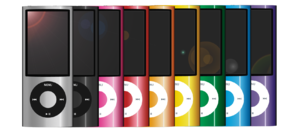
At Apple's September 9, 2009 event, a fifth generation iPod nano was unveiled with reduced prices on the larger model (at the time of release, the 8GB is priced at $149 and the 16GB at $179), a new glossy case, larger, 2.2" diagonal screen (up from 2.0" in third and fourth generation iPod nanos), which is also wider, integrated video camera with special effects, microphone, FM Radio with iTunes tagging (via RDS) and Live Pause, Nike+iPod Support and speaker (features more anticipated with the iPod Touch). The 5G iPod nano has 9 finishes: Silver, Black, Purple, Light Blue, Dark Green, Yellow, Orange, PRODUCT RED and Pink. Just like the 4G iPod nano, PRODUCT RED is only available on the Apple Online Store and Apple Retail Store as well as yellow.

iPod nano


A fourth-generation iPod nano

At the Apple Let's Rock Event on September 9, 2008, the iPod nano 4th Generation was officially announced. It returns to the narrow form factor of the 1st and 2nd Generation model, while retaining and rotating the 2-inch (51 mm) screen from the 3G model. It is also thinner than the 1G, 2G and 3G, measuring 90.7 mm (3.6 inches) tall by 38.7 mm (1.5 inches) wide by 6.2 mm (0.24 inch) thick, and weighing 36.8 grams (1.3 ounces). It has a curved aluminum shell and glass screen (the glass screen being held in place with nothing but the shell). The battery is claimed to last 24 hours of music playback, and only 4 hours of video playback, compared to the 5 hours of the previous generation.

The six previous colors (silver, black, mint, turquoise, berry red, and rose pink) have been replaced by silver, black, purple, light blue, green, yellow, orange, red, and pink, for a total of nine, although the Product Red color is only available directly from Apple (website and retail stores). Apple markets the new colors as "nano-chromatic". Also added is an accelerometer which allows the Nano to shuffle songs by shaking it, the option between portrait and landscape display modes by tilting the iPod left or right, and access to Cover Flow when tilted sideways. Videos, however, can only be played in landscape mode. The user interface has also been refreshed, adding a more stylized look in keeping with the new hardware design. It includes a new voice recording feature which starts automatically when an Apple compatible microphone is plugged in. It also includes the new "Genius" feature, introduced by Apple the same day. The Genius feature automatically creates playlists based on a selected song using an algorithm built by Apple.

It is additionally touted as "the most environmentally friendly iPod Apple has ever made", containing arsenic-free glass and a BFR-, mercury-, and PVC-free design. It is also claimed to be highly recyclable. The iPod nano 4G is shipped in cases similar to the 2G ones with the clear view in the front, and is marketed in two models: 8 GB and 16 GB. Limited quantities of an unannounced 4 GB model have surfaced in various markets Also, the iPod Quiz game was dropped and replaced with a Maze game which makes use of the iPod's accelerometer similarly to such games on the iPhone and iPod Touch.

The fourth generation drops support for charging via FireWire. "This change means that any dock accessories that use the dock connector's FireWire pins to send power--many older speakers and car chargers, for example--will not charge the 4G iPod nano.

iPod


A black 8 GB third generation iPod nano.

Apple updated the Nano again on September 5, 2007. The third-generation Nano features a 2-inch (51 mm) QVGA (320 x 240) screen and a shorter, wider, heavier design, with new colors. New features include browsing via Cover Flow, a new user interface and video playback. Users must repurchase games bought before a month prior to the debut of the new iPod as they are not supported. The Nano was announced in a 4 GB version coming in silver and an 8 GB version coming in silver, turquoise, mint green, black, and Product Red. The battery lasts for approx. 24 hours on audio playback and approx. 5 hours on video playback. On January 22, 2008, Apple released a pink version of the 8 GB iPod nano.

Combining elements from previous generations of the iPod nano, the third-generation Nano has an aluminum front plate and a stainless steel back plate. The Nano also sports a new Minimalistic hold switch, similar to the iPod Shuffle's power switch, which has been moved to the bottom of the player. The 2-inch (51 mm) screen has the smallest dot pitch of any Apple product, having the same pixel count as the 2.5-inch (64 mm) display of the iPod Classic.

On October 6, 2007, Apple released a firmware update (1.0.2) via iTunes that is said to improve Cover Flow and yield faster menu navigation. The update was also released for the iPod Classic. On November 28, 2007, Apple released another firmware update (1.0.3) via iTunes, which included unspecified bugfixes. January 15, 2008 saw the release of version 1.1, which added support for iTunes movie rentals, music song lyrics support and included more unspecified bugfixes. In May 2008, Apple released update version 1.1.2. In July 2008, Apple released update 1.1.3.

iPod


The second generation iPod nano, in Product Red.

On September 12, 2006, Apple updated the Nano line. The second-generation Nano features scratch-resistant, anodized aluminum casing like the earlier Mini's design; the multiple color choices (silver, green, pink, blue, and black) mirror that of the Mini as well. However, unlike the second-generation Mini, the button labels do not match the color of the Nano. Instead, they are gray, like the first-generation Mini, except for the black iPod which has a black click wheel. The second-generation Nano features "a brighter, more vibrant display",[22] a battery life upgrade (from 14 to 24 hours), and doubled storage sizes with the new 2, 4, and 8 GB models (compared to the previous 1, 2, and 4 GB models). The second generation iPod nanos also support gapless playback of audio files, a new search option, and a 40 percent brighter screen. The 2 GB model was available in silver only. The 4 GB was initially available in green, blue, silver, or pink. The 8 GB model was initially only available in black but Product Red was later added. Apple claims that the second generation iPod nano's packaging is "32% lighter and uses 52% less volume than the first generation", thereby reducing environmental impact and shipping cost at the same time.

On October 13, 2006, Apple announced a special edition iPod nano Product Red, with a red exterior and 4 GB of storage. For each red iPod nano sold in the United States, Apple donates US$10 to the Product Red initiative, while retaining the regular price. On November 3, 2006, Apple introduced a red 8 GB model, due to "outstanding customer demand", while also retaining the same price point of the black model with an equally large storage capacity.

On December 26-27 2006, Apple Computer's website and servers had crashed due to people downloading iTunes software since so many iPods were sold that Christmas season.

Incidents

In Australia, an iPod nano caught fire while being charged on a PC. Since the limited warranty was over, the consumer was not able to get a replacement right away.

Another iPod incident happened in the Hartsfield-Jackson Atlanta International Airport while a man was working in the airport. His iPod nano set his pants on fire. Apple Inc. refused to release a statement regarding this issue.

In addition, an iPod nano sparked in Japan in January while it was recharging. Although no one was injured during the incident, Apple Inc. is currently investigating it. It was reported on August 19, 2008 that 17 incidents of abnormal overheating with 1st-generation iPod nano units while recharging had been reported in Japan, including cases in which tatami mats had been charred.[

Criticism


The first generation iPod nano packaging.

The size of the package was reduced 50 percent with the introduction of the second generation. The fourth generation mimics this packaging, while the third generation used a larger but otherwise similar version of it.

The initial consumer response to the iPod nano was overwhelmingly positive and sales were heavy. The Nano sold its first million units in only 17 days, helping Apple Inc. to a record billion-dollar profit in 2005.

Apple's release of the iPod Nano as a replacement for the iPod Mini was viewed by many as a risky move. Steve Jobs has argued that the iPod nano was a necessary risk since competitors were beginning to catch up to the iPod Mini in terms of design and features, and believed the iPod nano would prove to be even more popular and successful than the iPod Mini.

Within days of the Nano's release, some users reported damage to the Nano, suggesting that the LCD screen had become so scratched that it was unreadable, even when the backlight was on. Many have reported fine scratches on their Nano caused by microfiber cloths. Other owners reported that their Nano's screen cracked with no provocation. On September 27, 2005, Apple confirmed a small percentage ("less than 1/10 of 1 percent") of iPod nanos shipped with a faulty screen and agreed to replace any Nanos with cracked screens, but denied the iPod nano was more susceptible to scratching than prior iPods. Apple started shipping iPod nanos with a protective sleeve to protect them from scratches. In October 2005, a class action lawsuit was filed against Apple, with the plaintiffs seeking reimbursement for the device, legal fees, and "unlawful or illegal profits" from sales of the iPod nano. Lawyers for the plaintiffs claim that the devices "scratch excessively during normal usage, rendering the screen on the Nanos unreadable, and violating state consumer protection statutes". Similar lawsuits were later filed in Mexico and the United Kingdom. As of early 2009, Apple is in the process of settling a court case over the scratched iPod nano screens, it has been suggested for Apple to set aside $22 million to refund users. A Judge will need to sign off the terms by April 28, 2009. Some commentators such as BusinessWeek's Arik Hesseldahl have criticized the lawsuits. Hesseldahl dismissed them as "stupid" and suggested that they benefitted "no one but the trial lawyers," but also suggested that Apple could have avoided litigation by offering "full refunds on unwanted Nanos" instead of charging a re-stocking fee and lengthening the return period from 14 days (when purchased through Apple retail or online) to 30 or 60 days.

iPod nano.


Black first-generation iPod nano.

Advertising emphasized the iPod nano's small size: it is 1.6 in (40 mm) width, 3.5 in (90 mm) length, 0.27 in (6.9 mm) thick and weighs 1.5 ounces (42 grams). Its stated battery life is up to 14 hours. The screen is 176 x 132 pixels, 1.5 in (38 mm) diagonal, and can display 65,536 colors (16-bit color).

History

Development work on the design of the iPod nano started only nine months before its launch date. The Nano was launched in two colors (black and white) with two available sizes: 2 GB (roughly 500 songs) and 4 GB (1000 songs). On February 7, 2006, Apple updated the lineup with the 1 GB model (240 songs). Apple also released some accessories, including armbands and silicone "tubes" designed to bring color to the Nano and protect it from scratches, as well as a combination lanyard-earphone accessory that hangs around the neck, and avoids the problem of tangled earphone cords.

Electronics

The iPod nano uses general-purpose integrated circuits (IC) instead of smaller, low-cost custom-developed chips, possibly to reduce time-to-market. This design, however, increases the number of electronic components and increases the cost. Japanese engineers estimated the component cost of the 2 GB Nano as between JP¥22,000 and JP¥27,000 (US$185-US$227), which was high compared to the retail price of JP¥21,800 (US$183) at the time. The cost of 2 GB Nano flash memory was about JP¥14,000 (US$118). Apple also opted for the 0603 (1.6x0.8 mm) surface mount technology which was just beginning widespread use in mobile phones in 2005. The iPod nano uses a PortalPlayer PP5021C "system on a chip" with dual embedded 80 MHz ARM 7TDMI processors.[

iPod nano


IPod nano 5G.png
iPod nano 5th generation
Manufacturer Apple Inc.
Type Portable media player
Retail availability September 7, 2005-present
Media Flash memory from 1 to 16 GB
(currently 8 and 16 GB)
Operating system 1.3.1 (1st Generation)
1.1.3 (2nd Generation)
1.1.3 (3rd Generation)
1.0.4 (4th Generation)
1.0.1 (5th Generation)

Power Lithium ion battery
Display 176 x 132 1.5" color LCD (1G/2G)
320 x 240 2" color LCD 3G
240 x 320 2" color LCD 4G
240 x 376 2.2" color TFT-LCD 5G
Input Click Wheel/Accelerometer
Connectivity iPod 30-pin or 32-pin Dock Connector
USB 2.0
Predecessor iPod Mini
Related articles iPod Classic
iPod Shuffle
iPod Touch

The iPod nano is a portable media player with a video camera designed and marketed by Apple. The first generation of the iPod nano was introduced in 2005. It uses flash memory, like the iPod Shuffle, but with a 2.2 inch (diagonal) QVGA display and the "click wheel" found on the iPod Classic. The iPod nano has gone through five models, or generations, since its introduction. The fifth generation (current) supports video recording, a microphone for voice memos, a pedometer, and a slightly larger screen than that of the previous generation.

worker exploitation

On 11 June 2006, the British tabloid The Mail on Sunday reported that iPods are mainly manufactured by workers who earn no more than US$50 per month and work 15-hour shifts. Apple investigated the case with independent auditors and found that, while some of the plant's labour practices met Apple's Code of Conduct, others did not: Employees worked over 60 hours a week for 35% of the time, and worked more than six consecutive days for 25% of the time.

Foxconn, Apple's manufacturer, initially denied the abuses, but when an auditing team from Apple found that workers had been working longer hours than were allowed under Chinese law, they promised to prevent workers working more hours than the code allowed. Apple hired a workplace standards auditing company, Verité, and joined the Electronic Industry Code of Conduct Implementation Group to oversee the measures. On 31 December 2006, workers at the Longhua, Shenzhen factory (owned by Foxconn) formed a union. The union is affiliated with the world's largest and most powerful federation of trade unions, the All-China Federation of Trade Unions.

Reliability and durability

iPods have been criticized for their short life-span and fragile hard drives. A 2005 survey conducted on the MacInTouch website found that the iPod line had an average failure rate of 13.7% (although they note that comments from respondents indicate that "the true iPod failure rate may be lower than it appears"). It concluded that some models were more durable than others. In particular, failure rates for iPods employing hard drives was usually above 20% while those with flash memory had a failure rate below 10%, indicating poor hard drive durability. In late 2005, many users complained that the surface of the first generation iPod Nano can become scratched easily, rendering the screen unusable. A class action lawsuit was also filed. Apple initially considered the issue a minor defect, but later began shipping these iPods with protective sleeves.

Battery problems

The advertised battery life on most models is different from the real-world achievable life. For example, the fifth generation 30 GB iPod is advertised as having up to 14 hours of music playback. An MP3.com report stated that this was virtually unachievable under real-life usage conditions, with a writer for MP3.com getting on average less than 8 hours from an iPod.[77] In 2003, class action lawsuits were brought against Apple complaining that the battery charges lasted for shorter lengths of time than stated and that the battery degraded over time.[78] The lawsuits were settled by offering individuals either US$50 store credit or a free battery replacement.

iPod batteries are not designed to be removed or replaced by the user, although some users have been able to open the case themselves, usually following instructions from third-party vendors of iPod replacement batteries. Compounding the problem, Apple initially would not replace worn-out batteries. The official policy was that the customer should buy a refurbished replacement iPod, at a cost almost equivalent to a brand new one. All lithium-ion batteries eventually lose capacity during their lifetime (guidelines are available for prolonging life-span) and this situation led to a market for third-party battery replacement kits.

Apple announced a battery replacement program on 14 November 2003, a week before a high publicity stunt and website by the Neistat Brothers. The initial cost was US$99, and it was lowered to US$59 in 2005. One week later, Apple offered an extended iPod warranty for US$59.For the iPod Nano, soldering tools are needed because the battery is soldered onto the main board. Fifth generation iPods have their battery attached to the backplate with adhesive.

Sales


iPod quarterly sales. Click for table of data and sources. Note that Q1 is October through December of previous year, the holiday season.

Since October 2004, the iPod line has dominated digital music player sales in the United States, with over 90% of the market for hard drive-based players and over 70% of the market for all types of players. During the year from January 2004 to January 2005, the high rate of sales caused its U.S. market share to increase from 31% to 65% and in July 2005, this market share was measured at 74%. In January 2007 the iPod market share reached 72.7% according to Bloomberg Online.

The release of the iPod Mini helped to ensure this success at a time when competing flash-based music players were once dominant. On 8 January 2004, Hewlett-Packard (HP) announced that they would sell HP-branded iPods under a license agreement from Apple. Several new retail channels were used—including Wal-Mart—and these iPods eventually made up 5% of all iPod sales. In July 2005, HP stopped selling iPods due to unfavorable terms and conditions imposed by Apple.

In January 2007, Apple reported record quarterly revenue of US$7.1 billion, of which 48% was made from iPod sales.

On 9 April 2007, it was announced that Apple had sold its one-hundred millionth iPod, making it the biggest selling digital music player of all time. In April 2007, Apple reported second quarter revenue of US$5.2 billion, of which 32% was made from iPod sales. Apple and several industry analysts suggest that iPod users are likely to purchase other Apple products such as Mac computers.

On 5 September 2007, during their "The Beat Goes On" event, Apple announced that the iPod line had surpassed 110 million units sold.

On 22 October 2007, Apple reported quarterly revenue of US$6.22 billion, of which 30.69% came from Apple notebook sales, 19.22% from desktop sales and 26% from iPod sales. Apple's 2007 year revenue increased to US$24.01 billion with US$3.5 billion in profits. Apple ended the fiscal year 2007 with US$15.4 billion in cash and no debt.

On 22 January 2008, Apple reported the best quarter revenue and earnings in Apple's history so far. Apple posted record revenue of US$9.6 billion and record net quarterly profit of US$1.58 billion. 42% of Apple's revenue for the First fiscal quarter of 2008 came from iPod sales, followed by 21% from notebook sales and 16% from desktop sales.

On 21 October 2008, Apple reported that only 14.21% of total revenue for fiscal quarter 4 of year 2008 came from iPods.. At the September 9, 2009 keynote presentation at the Apple Event, Phil Schiller announced total cumulative sales of iPods had exceeded 220 million.

Patent disputes

In 2005, Apple faced two lawsuits claiming patent infringement by the iPod line and its associated technologies: Advanced Audio Devices claimed the iPod line breached its patent on a "music jukebox", while a Hong Kong-based IP portfolio company called Pat-rights filed a suit claiming that Apple's FairPlay technology breached a patent issued to inventor Ho Keung Tse. The latter case also includes the online music stores of Sony, RealNetworks, Napster, and Musicmatch as defendants.

Apple's application to the United States Patent and Trademark Office for a patent on "rotational user inputs", as used on the iPod interface, received a third "non-final rejection" (NFR) in August 2005. Also in August 2005, Creative Technology, one of Apple's main rivals in the MP3 player market, announced that it held a patent on part of the music selection interface used by the iPod line, which Creative dubbed the "Zen Patent", granted on 9 August 2005. On 15 May 2006, Creative filed another suit against Apple with the United States District Court for the Northern District of California. Creative also asked the United States International Trade Commission to investigate whether Apple was breaching U.S. trade laws by importing iPods into the United States.

On 24 August 2006, Apple and Creative announced a broad settlement to end their legal disputes. Apple will pay Creative US$100 million for a paid-up license, to use Creative's awarded patent in all Apple products. As part of the agreement, Apple will recoup part of its payment, if Creative is successful in licensing the patent. Creative then announced its intention to produce iPod accessories by joining the Made for iPod program.

Models

List of iPod models

Model Generation Image Capacity Connection Original release date Minimum OS to sync Rated battery life (hours)
Classic first first generation iPod 5, 10 GB FireWire 23 October 2001 Mac: 9, 10.1 audio: 10
First model, with mechanical scroll wheel. 10 GB model released later.
second A second generation iPod (2002) 10, 20 GB FireWire 17 July 2002 Mac: 10.1
Win: 2000
audio: 10
Touch-sensitive wheel. FireWire port had a cover. Hold switch revised. Windows compatibility through Musicmatch.
third third generation iPod 10, 15, 20, 30, 40 GB FireWire (USB for syncing only) 28 April 2003 Mac: 10.1
Win: 2000
audio: 8
First complete redesign with all-touch interface, dock connector, and slimmer case. Musicmatch support dropped with later release of iTunes 4.1 for Windows.
fourth
(Photo)
(Color)
fourth generation iPod 20, 40 GB FireWire or USB 19 July 2004 Mac: 10.2
Win: 2000
audio: 12
Adopted Click Wheel from iPod Mini, hold switch redesigned.
fourth generation iPod with color display photo:
30, 40, 60 GB
FireWire or USB 26 October 2004 Mac: 10.2
Win: 2000
audio: 15
slideshow: 5
color:
20, 60 GB
28 June 2005
Premium spin-off of 4G iPod with color screen and picture viewing. Later re-integrated into main iPod line.
fifth fifth generation iPod 30, 60, 80 GB USB (FireWire for charging only) 12 October 2005 Mac: 10.3
Win: 2000
30 GB
audio: 14
video: 2
(later 3.5)
60/80 GB
audio: 20
video: 3/6.5
Second full redesign with a slimmer case, and larger screen with video playback. Offered in black or white. Hardware and firmware updated with 60 GB model replaced with 80 GB model on 12 September 2006.
sixth sixth generation iPod 80, 120, 160 GB USB (FireWire for charging only) 5 September 2007 Mac: 10.4
Win: XP
80 GB
audio: 30
video: 5
120 GB
audio: 36
video: 6
160 GB
2007 model
audio: 40
video: 7
2009 model
audio: 36
video: 6
Introduced the "Classic" suffix. New interface and anodized aluminum front plate. Silver replaces white. In September 2008 the hardware and firmware was updated with a 120 GB model replacing the 80 GB model and the 160 GB model was discontinued. In September 2009 the 120GB model was replaced with a 160GB model.
Mini first first generation iPod Mini 4 GB USB or FireWire 6 January 2004 Mac: 10.1
Win: 2000
audio: 8
New smaller model, available in 5 colors. Introduced the "Click Wheel".
second second generation iPod Mini 4, 6 GB USB or FireWire 22 February 2005 Mac: 10.2
Win: 2000
audio: 18
Brighter color variants with longer battery life. Click Wheel lettering matched body color. Gold color discontinued. Later replaced by iPod Nano.
Nano first first generation iPod Nano 1, 2, 4 GB USB (FireWire for charging only) 7 September 2005 Mac: 10.3
Win: 2000
audio: 14
slideshow: 4
Replaced Mini. Available in black or white and used flash memory. Color screen for picture viewing. 1 GB version released later.
second 4 GB blue iPod Nano 2, 4, 8 GB USB (FireWire for charging only) 12 September 2006 Mac: 10.3
Win: 2000
audio: 24
slideshow: 5
Anodized aluminum casing and 6 colors available.
third 4 GB third generation iPod Nano 4, 8 GB USB (FireWire for charging only) 5 September 2007 Mac: 10.4
Win: XP
audio: 24
video: 5
2" QVGA screen, colors refreshed with chrome back, new interface, video capability, smaller Click Wheel.
fourth 16 GB Flash Drive fourth generation iPod Nano 4, 8, 16 GB USB 9 September 2008 Mac: 10.4
Win: XP
audio: 24
video: 4
Revert to tall form and all-aluminum enclosure with 9 color choices, added accelerometer for shake and horizontal viewing. 4 GB model limited release in select markets.
fifth 16 GB Flash Drive fifth generation iPod Nano with camera 8, 16 GB USB 9 September 2009 Mac: 10.4
Win: XP
audio: 24
video: 5
First iPod to include a video camera; also included a larger screen, an FM radio, a speaker, a pedometer, and a polished exterior case while retaining the same colors as the fourth generation model.
Shuffle first first generation iPod shuffle 512 MB, 1 GB USB
(no adaptor required)
11 January 2005 Mac: 10.2
Win: 2000
audio: 12
New entry-level model. Uses flash memory and has no screen.
second second generation iPod shuffle 1, 2 GB USB 12 September 2006 Mac: 10.3
Win: 2000
audio: 12
Smaller clip design with anodized aluminum casing. 4 color options added later. Colors were later refreshed twice.
third third generation iPod shuffle 2, 4 GB USB 11 March 2009 Mac: 10.4
Win: XP
audio: 10
Smaller design with controls relocated to right earbud cable. Introduced with two colors, and features VoiceOver. More colors and 2GB model added in September 2009.
Touch first The originial iPod Touch. 8, 16, 32 GB USB (FireWire for charging only)[citation needed] 5 September 2007 Mac: 10.4
Win: XP
audio: 22
video: 5
First iPod with Wi-Fi and a Multi-Touch interface. Features Safari browser and wireless access to the iTunes Store and YouTube. 32 GB model later added. iPhone OS 2.0 and App Store access requires an upgrade fee.
second Second generation iPod Touch. 8, 16, 32 GB USB 9 September 2008 Mac: 10.4
Win: XP
audio: 36
video: 6
New tapered chrome back with Nike+ functionality, volume buttons, and built-in speaker added. iPhone OS 2.0 and App Store access standard. Bluetooth support added but not made active until iPhone OS 3.0, which requires an upgrade fee.
third 32, 64 GB USB 9 September 2009 Mac: 10.4
Win: XP
audio: 30
video: 6
Updated to include the upgraded internals from the iPhone 3GS; includes Voice Control support and bundled remote earphones.

Audio performance

The third generation iPod had a weak bass response, as shown in audio tests. The combination of the undersized DC-blocking capacitors and the typical low-impedance of most consumer headphones form a high-pass filter, which attenuates the low-frequency bass output. Similar capacitors were used in the fourth generation iPods. The problem is reduced when using high-impedance headphones and is completely masked when driving high-impedance (line level) loads, such as an external headphone amplifier. The first generation iPod Shuffle uses a dual-transistor output stage, rather than a single capacitor-coupled output, and does not exhibit reduced bass response for any load.

From the 5th generation iPod on, Apple introduced a user-configurable volume limit in response to concerns about hearing loss. Users report that in the 6th generation iPod, the maximum volume output level is limited to 100dB in EU markets. Apple previously had to remove iPods from shelves in France.

Accessories

Many accessories have been made for the iPod line. A large number are made by third party companies, although many, such as the late iPod Hi-Fi, are made by Apple. This market is sometimes described as the iPod ecosystem. Some accessories add extra features that other music players have, such as sound recorders, FM radio tuners, wired remote controls, and audio/visual cables for TV connections. Other accessories offer unique features like the Nike+iPod pedometer and the iPod Camera Connector. Other notable accessories include external speakers, wireless remote controls, protective cases/films and wireless earphones. Among the first accessory manufacturers were Griffin Technology, Belkin, JBL, Bose, Monster Cable, and SendStation.


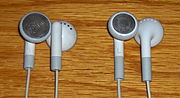
Two designs of iPod earphones. The current version is shown on the right.

BMW released the first iPod automobile interface,[31] allowing drivers of newer BMW vehicles to control an iPod using either the built-in steering wheel controls or the radio head-unit buttons. Apple announced in 2005 that similar systems would be available for other vehicle brands, including Mercedes-Benz,[32] Volvo,[33] Nissan, Toyota,[34] Alfa Romeo, Ferrari,[35] Acura, Audi, Honda,[36] Renault, Infiniti[37] and Volkswagen.[38] Scion offers standard iPod connectivity on all their cars.

Some independent stereo manufacturers including JVC, Pioneer, Kenwood, Alpine, Sony, and Harman Kardon also have iPod-specific integration solutions. Alternative connection methods include adaptor kits (that use the cassette deck or the CD changer port), audio input jacks, and FM transmitters such as the iTrip—although personal FM transmitters are illegal in some countries. Many car manufacturers have added audio input jacks as standard.

Beginning in mid-2007, four major airlines, United, Continental, Delta, and Emirates, reached agreements to install iPod seat connections. The free service will allow passengers to power and charge an iPod, and view video and music libraries on individual seat-back displays.Originally KLM and Air France were reported to be part of the deal with Apple, but they later released statements explaining that they were only contemplating the possibility of incorporating such systems.

Connectivity


Four iPod wall chargers for North America, all made by Apple. These have FireWire (left) and USB (right three) connectors, which allow iPods to charge without a computer. Notice how the units have been miniaturized, although those for other countries are often larger.

Originally, a FireWire connection to the host computer was used to update songs or recharge the battery. The battery could also be charged with a power adapter that was included with the first four generations. The third generation began including a 30-pin dock connector, allowing for FireWire or USB connectivity. This provided better compatibility with non-Apple machines, as most of them did not have FireWire ports at the time. Eventually Apple began shipping iPods with USB cables instead of FireWire, although the latter was available separately. As of the first generation iPod Nano and the fifth generation iPod Classic, Apple discontinued using FireWire for data transfer (while still allowing for use of FireWire to charge the device) in an attempt to reduce cost and form factor. As of the second-generation iPod Touch and the fourth-generation iPod Nano, FireWire charging ability has been removed. The second and third generation iPod Shuffle uses a single 3.5 mm jack which acts as both a headphone jack and a data port for the dock.

The dock connector also allowed the iPod to connect to accessories, which often supplement the iPod's music, video, and photo playback. Apple sells a few accessories, such as the now-discontinued iPod Hi-Fi, but most are manufactured by third parties such as Belkin and Griffin. Some peripherals use their own interface, while others use the iPod's own screen. Because the dock connector is a proprietary interface, the implementation of the interface requires paying royalties to Apple.